
An Arabic WhatsApp Order Agent for a B2B Dessert Lab in Riyadh
AI SUPPORT AGENTWHATSAPPARABIC NLPN8NAUTOMATION
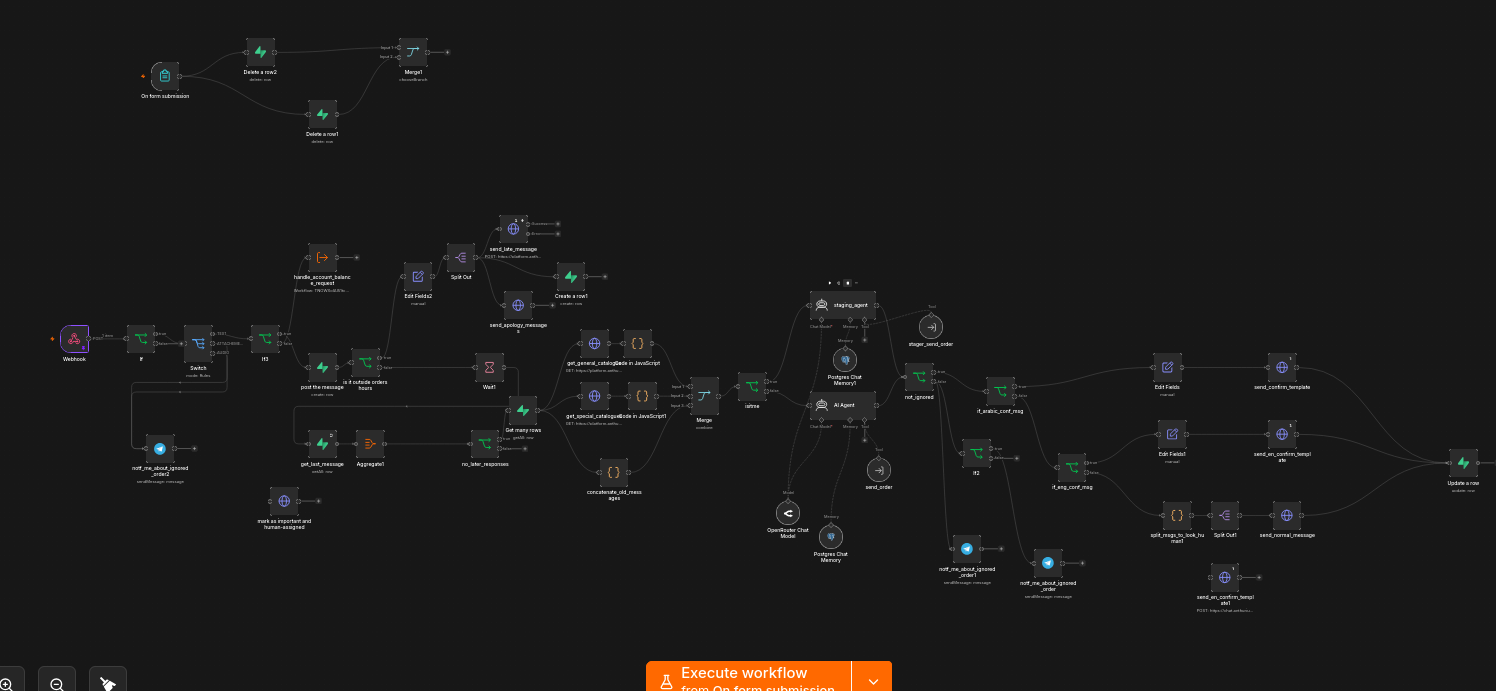
Anthurium is a dessert lab in Riyadh. It does not sell to walk-in customers; it supplies cafés and bakeries that reorder the same trays and cakes every week. Those orders arrive as WhatsApp messages, in Arabic, written by busy café staff. I built the agent that reads them and turns them into orders the kitchen can actually make.
The problem
A person was reading every message and writing every order by hand. That works until a long day gets in the way. The same café orders slightly differently each time, the catalog has more than fifty products, and one order can list six items with quantities. Somewhere in the afternoon a 3 becomes an 8, and a tray of something goes out that nobody ordered. The job was to take these orders without getting them wrong.The constraints
Wholesale has rules a normal shop bot never deals with. There is a minimum order. There is a daily cutoff, after which an order rolls to the next production day. Delivery is Riyadh only. And every client has a six-digit account number, which is not their phone number, that the agent checks before it does anything else. The confidentiality rule was the hard one. A few cafés have private products made only for them. Those cannot appear for anyone else, and the agent cannot even hint that private products exist. One wrong listing and a café learns what a competitor is selling.The approach
The agent reads the client's language and answers in it, takes the order item by item against the real catalog, and refuses to guess. If it cannot match a product, it asks. If the account number is wrong, it asks again instead of carrying on. Anything it is unsure about goes to a human. The catalog caused the worst bug. It lives in the accounting system, and I first let a sync copy it straight into the agent's database. Then the hand-set flags that mark a product private to one café got overwritten on the next sync, and the private rule broke without any error. The fix was to let the sync own only the columns it should own, the names and prices, and leave the private flags alone.The build
The order flow is a short set of steps the agent repeats every time: confirm who you are, take the items, show the total with delivery, confirm, then create the order. The totals and the product IDs come from the catalog every time, never from the model's memory, because a price the model recalls is one that will eventually be wrong. Reading the items took the most iterations. Real messages are messy: a quantity, a product, a size and a note in one Arabic sentence, sometimes mixing dialect and standard Arabic. Getting that reading right matters more than anything else, because a wrong reading becomes a wrong delivery, and a wrong delivery becomes a returned box. Most of the work was not the conversation. It was the checks around it: identity, minimum, cutoff, confidentiality, and one source of truth for prices.Results
- Wholesale orders taken over WhatsApp in Arabic, validated against the live catalog
- Client identity, minimum order and cutoff checked before any order is created
- Private per-client products stay private, enforced in the data and not only in the prompt
- The owner stopped transcribing orders by hand and moved to confirming and dispatching them